In This Guide
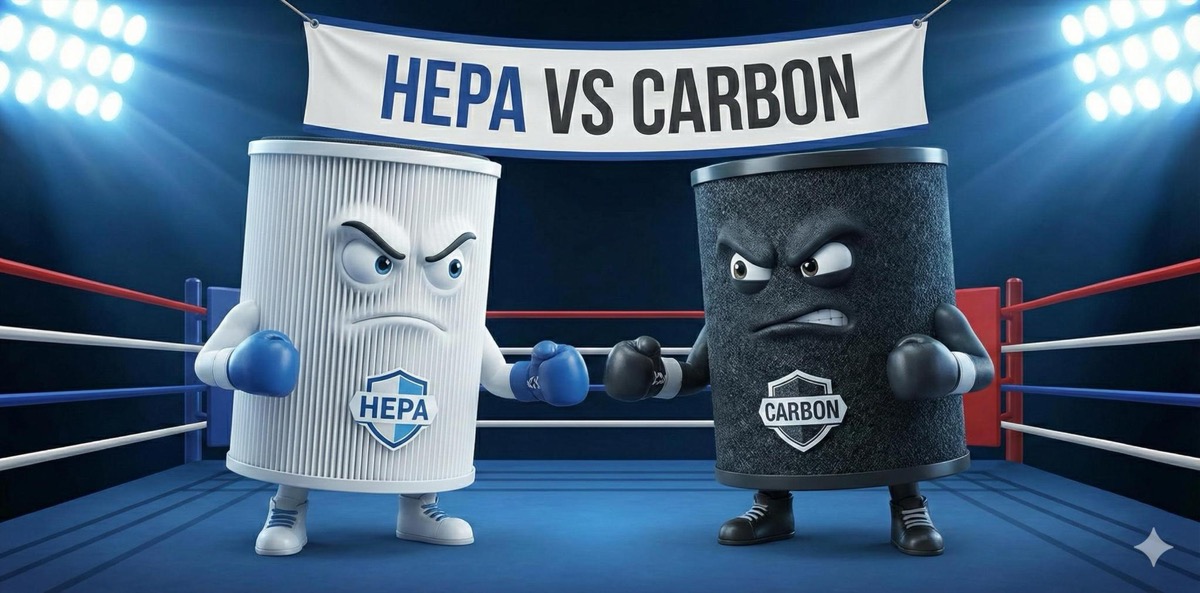
If you are shopping for an air purifier, you will hear a lot about HEPA filters and carbon filters. The marketing language suggests they do similar things. They don't. HEPA and carbon filters are fundamentally different technologies that remove completely different contaminants from your air. Understanding what each one does - and more importantly, what it does NOT do - is the key to buying a purifier that actually solves your air quality problem instead of just looking like it does.
This guide breaks down how both filters work at a mechanical level, what they capture and what they miss, and the practical differences between "true HEPA," "HEPA-type," and the other marketing variations you will see on product listings. We'll cover the specific use cases where you need one, both, or neither - and how to identify which purifier is right for your home.
How HEPA Filters Work: Mechanical Filtration
A HEPA filter is a mechanical barrier made of extremely fine fibers (usually fiberglass) arranged in a dense mat. When air flows through the filter, solid particles get trapped by three mechanisms: interception, impaction, and diffusion.
The Three Mechanisms of HEPA Capture
Interception
A particle moving along an air stream comes within one particle radius of a fiber and sticks to it. This works for particles as small as 0.3 microns.
Impaction
A larger particle cannot follow the air stream around a fiber and crashes directly into it, getting stuck. This is the dominant mechanism for particles over 1 micron.
Diffusion
Extremely small particles (below 0.3 microns) move randomly and eventually hit a fiber. These ultra-fine particles are captured through Brownian motion rather than following the air stream.
The 0.3 Micron Standard
True HEPA filters are rated to capture 99.97% of particles at 0.3 microns and larger. Why 0.3 microns? That is where the three capture mechanisms intersect with peak efficiency. Below 0.3 microns, diffusion (Brownian motion) becomes more effective. Above 0.3 microns, interception and impaction dominate. At exactly 0.3 microns, all three mechanisms are at work, creating a theoretical weak point - this is where HEPA certification is tested.
In practice, HEPA filters capture particles well above and below 0.3 microns. A real HEPA filter catches pollen (10-100 microns), pet dander (2.5-10 microns), dust (0.5-100 microns), mold spores (2-20 microns), and even some bacteria (0.5-5 microns) with exceptional efficiency. The 0.3 micron rating simply tells you the absolute minimum threshold.
What HEPA Removes
- Pollen: 10-100 microns - eliminated with 99.97% efficiency
- Pet dander: 2.5-10 microns - eliminated with 99.97% efficiency
- Dust mite debris: 5-10 microns - eliminated with 99.97% efficiency
- Dust: 0.5-100 microns - eliminated with 99.97% efficiency
- Mold spores: 2-20 microns - eliminated with 99.97% efficiency
- Bacteria: 0.5-5 microns - eliminated with 99.97% efficiency
- Some viruses: Virus particles riding on dust (secondary removal only; viruses alone are too small)
Why HEPA Filters Clog
A HEPA filter's job is to catch and hold particles permanently. As it works, more and more particles build up in the fibers. Eventually, the filter becomes so saturated that airflow becomes restricted. This is why filter replacement is necessary - a clogged HEPA filter not only restricts airflow but can actually begin releasing trapped particles back into the air as pressure builds up behind the blockage. Most HEPA filters need replacement every 6-12 months with continuous use.
How Activated Carbon Filters Work: Adsorption
Activated carbon works through an entirely different process called adsorption (not absorption). Adsorption is when molecules bond to the surface of a material. In the case of carbon, that material has been chemically treated and heated to create millions of tiny pores, dramatically increasing its surface area. A single gram of activated carbon can have a surface area of 3,000 square meters - the size of a football field compressed into the weight of a raisin.
How Adsorption Works
When air passes through a carbon filter, gas molecules and odor molecules stick to the carbon surface through weak intermolecular forces (van der Waals forces). This is not mechanical trapping like HEPA; it is chemical bonding at the molecular level. Once bonded, molecules stay stuck to the carbon until the filter is saturated - at which point no more molecules can attach, and the filter stops working.
What Activated Carbon Removes
- Cooking odors: Smoke, burnt food, spice volatiles - removed at source
- Volatile Organic Compounds (VOCs): Paint fumes, new furniture off-gassing, solvent vapors
- Household chemical odors: Cleaning products, air fresheners, detergent residue
- Pet urine odors: Proteins and ammonia compounds that trigger allergic responses
- Tobacco smoke: Secondhand smoke odor and residual gases
- Mold spore gases: Not the mold spores themselves (those need HEPA), but the volatile compounds they release
- Car exhaust: NOx and other gaseous pollutants from nearby traffic
- Chlorine: From tap water or cleaning with bleach
Carbon Filter Saturation
Unlike a HEPA filter that gradually restricts airflow as it clogs, a carbon filter reaches a saturation point where it simply stops working - and you cannot see it. A saturated carbon filter looks clean and passes air normally, but it is no longer removing odors or gases. This is why carbon filters typically need replacement every 3-6 months, much more frequently than HEPA filters. If you have pets, heavy cooking, or live in a polluted area, expect the shorter end of that range.
What HEPA Filters Cannot Remove (Critical to Understand)
This is the key point that separates informed buyers from the confused. HEPA filters are brilliant at removing particles. They remove ONLY particles. Everything else passes straight through.
HEPA Does NOT Remove Gases
Gaseous molecules are far smaller than any particle. They move independently through the air and cannot be mechanically trapped. A HEPA filter will not remove cooking smoke's odor (which is gaseous), pesticide off-gassing, paint fumes, VOCs from new construction, or car exhaust. If you smell something, HEPA alone cannot fix it. You need carbon. (The EPA's guide to air cleaners confirms this distinction.)
HEPA Does NOT Remove Odors
Odors are gaseous molecules. That wet dog smell is a collection of volatile compounds released from the dog's fur and urine. HEPA will remove the physical dander particles but not the odor molecules themselves. This is why pet owners often find that a HEPA-only purifier helps their allergies but does not solve the smell problem - the two are separate filtration challenges.
HEPA Does NOT Remove Chemical Off-Gassing
New furniture, new carpet, paint, and construction materials release volatile organic compounds (VOCs) into the air. These are gases and aerosols, not particles. HEPA passes them through. People sensitive to new-home smell or who have chemical sensitivities will not find HEPA sufficient without a carbon layer.
HEPA Does NOT Remove Radon or Radioactive Particles
Radon is a radioactive gas. Carbon filters can remove some radon, but even carbon is not reliably effective. For radon mitigation, you need active radon remediation at the source (basement ventilation) or specialized radon canisters, not an air purifier.
Practical Impact
If you buy a HEPA-only air purifier and expect it to solve your home's odor problem, you will be disappointed. If your issue is seasonal pollen allergies with no odor concerns, HEPA alone is fine. If you have pets, cook frequently, or have chemical sensitivities, a HEPA-only purifier is solving only half the problem.
What Carbon Filters Cannot Remove (Equally Critical)
Carbon filters are excellent at removing gases and odors. They remove ONLY gases and odors. Everything else passes straight through.
Carbon Does NOT Remove Particles
A dust particle, pollen grain, or speck of pet dander will pass through a carbon filter without being captured. Carbon is designed for molecules bonding to its surface, not for trapping solid particles. If you suffer from pollen allergies or have a pet and buy a carbon-only purifier expecting relief from dander, the filter will not help your allergies at all - it will only address the smell.
Carbon Does NOT Remove Allergens
Allergens are particles: pollen (particle), dust mite debris (particle), pet dander (particle), mold spores (particle). Carbon cannot capture any of them. An allergen-sufferer using a carbon-only purifier will see no improvement in sneezing, itching, or asthma symptoms. If allergens are your concern, you need HEPA. Period.
Carbon Does NOT Remove Dust
Dust is a solid particle ranging from 0.5 to 100 microns. It will flow straight through carbon without being trapped. A carbon-only purifier will not reduce dust accumulation on surfaces or improve air clarity for people with dust sensitivities.
Carbon Does NOT Improve Asthma Caused by Particles
Asthma triggered by dust, pollen, or pet dander is triggered by particles. Carbon addresses only the odor component. If someone's asthma is triggered by seasonal pollen, they need HEPA. If their asthma is triggered by the odor/chemical component of pets (which is real), carbon helps - but both triggers need both filters.
Practical Impact
If you buy a carbon-only air purifier for allergies or dust control, it will not work. Carbon is the supporting player - great for odors and gases, but useless for the particle-based problems that affect most people's indoor air quality. A quality air purifier includes both because most air quality problems have both a particle component and a gas/odor component.
True HEPA vs HEPA-Type vs HEPA-Like: Why the Terminology Matters
This is where marketing deception lives. The terminology around HEPA is strictly regulated, but only if manufacturers choose to follow the standard.
True HEPA (HEPA-Certified)
Standard: Captures 99.97% of particles at 0.3 microns and larger.
Regulation: Must be tested by an independent lab and meet AHAM (Association of Home Appliance Manufacturers) or equivalent certification. This is the gold standard and the only terminology worth trusting.
What to look for: The product explicitly states "True HEPA" or "HEPA-certified" with reference to specific efficiency numbers (99.97% at 0.3 microns). The filter is designed and manufactured to meet this standard.
HEPA-Type
Standard: No official standard. Marketing term only.
Reality: A "HEPA-type" filter might capture 85-90% of particles, or it might be a thin HEPA-like layer that does not meet the 99.97% threshold. There is no way to verify the actual performance without testing.
Impact: Over the course of 12 months, a 10-15% difference in capture efficiency compounds. A 99.97% efficient filter and an 85% efficient filter looking at the same room will produce dramatically different air quality outcomes by year's end.
HEPA-Like
Standard: No official standard. Marketing term only, often used for budget units.
Reality: Even more vague than "HEPA-type." This is often applied to thin electrostatic or spin-fiber filters that have HEPA-class performance under laboratory conditions but are not certified by any independent body.
Impact: You have no way to know if the filter works as advertised. Buyer beware.
Why the Difference Matters
Pollen allergy sufferer buys a "HEPA-type" purifier rated at 85% efficiency. True HEPA would catch 99.97% of pollen. The HEPA-type catches 85%. That 15% difference is 15% of pollen particles still in the air - enough to cause symptoms. Six months in, the owner assumes air purifiers do not work. The problem was not air purifiers; it was that the unit was not actually true HEPA.
Always Demand True HEPA
When shopping for an air purifier, accept nothing less than "True HEPA" or "HEPA-certified." If the product description says "HEPA-type" or "HEPA-like," it is not meeting the true HEPA standard, and you should question whether it will deliver the results you need. The certification costs manufacturers money, which is why some budget units skip it. If you need the performance, buy the certification.
Carbon Filter Quality Differences: Pellet vs Granular vs Cloth
Not all carbon filters are created equal. The form the carbon takes affects how fast it works and how effectively it handles your air's chemical load.
Activated Carbon Pellets
Form: Small beads of activated carbon loosely packed in the filter chamber or layer.
Surface area: High (beads have external and internal surface area exposed).
Advantages: Excellent surface area for adsorption; can hold a lot of odor and gas molecules before saturation; relatively inexpensive to produce.
Disadvantages: Air must slow down and pass through the bead layer carefully for molecules to adsorb effectively. Too fast, and air bypasses the carbon without full contact. Pellets can shift and develop channels where air escapes without filtration.
Best for: Units where airflow is not a constraint and you want long filter life (like the Coway AP-1512HH, which has a 12-month carbon-only pellet stage).
Granular Activated Carbon
Form: Crushed pellets pressed into a compressed, dense layer or block.
Surface area: High (crushed particles offer more edges and facets than intact pellets).
Advantages: Denser compression means less risk of air channels forming; more compact form factor; good for units where space is tight.
Disadvantages: Requires higher airflow to push air through the compressed layer, which can increase noise or power draw. May saturate faster than pellets if air is moving very quickly through the unit.
Best for: Mid-range purifiers where efficiency and space matter but airflow is still moderate.
Activated Carbon Cloth
Form: Activated carbon bonded to a fabric mesh or woven material, similar to a thin blanket.
Surface area: Moderate (less total surface area than pellets or granular, but the fabric acts as a support structure).
Advantages: Very efficient air passage - low resistance means high airflow without pressure drop. Fast-acting for immediate odor reduction. Easy to replace and handle.
Disadvantages: Saturates faster than pellet or granular carbon due to lower total mass. Typically needs replacement every 3-6 months rather than 6-12.
Best for: Units where fast odor reduction matters and filter replacement frequency is not a concern (like the Winix 5500-2, which includes a carbon sheet specifically for pet odors).
Quality Indicators
Regardless of form, look for a substantial carbon layer - not a thin coating. A true carbon filter stage should be at least 0.5 inches thick for pellet/granular or visible as a full-width sheet for cloth. A paper-thin carbon layer is mostly marketing; it does not have enough surface area to meaningfully impact odors or gases.
When You Need HEPA Only, Carbon Only, Both, or Neither
HEPA Only
Situation: You have seasonal pollen allergies or dust sensitivities. No pets. No cooking odors or chemical sensitivities. You want clean, allergen-free air.
Example: Pollen allergy sufferer in a home with no pets, non-smokers, minimal cooking, clean air to start with.
Recommendation: A quality true HEPA purifier is sufficient. The Coway AP-1512HH will deliver excellent results. You do not need to pay extra for carbon if particles are your only concern.
Carbon Only
Situation: You have odor or chemical sensitivity issues with no particle allergies. You need to remove cooking odors, pet smells, or off-gassing but do not have dust or pollen concerns.
Example: Person living in a new apartment off-gassing from paint and furniture, with no allergies.
Recommendation: Rare scenario. Carbon-only purifiers exist but are not common because most people have both particle and odor concerns. If this is your situation, a carbon-only unit works, but you are paying for something you do not need and may later regret the decision if you develop dust sensitivity.
Both HEPA and Carbon
Situation: You have allergies, pets, frequently cook, are sensitive to chemical odors, or live in an area with both particle and air quality concerns. This covers most households.
Example: Home with one or two pets, history of allergies, someone who cooks regularly, sensitivity to new-product odors.
Recommendation: Almost all quality air purifiers come with both, and for good reason. A two-stage filter addresses both the particle and gas components of indoor air quality. Invest in both. This is why nearly all mid-range and premium purifiers include both filters.
Neither (or Addressable by Source Control)
Situation: Your air quality is good. No allergies. No odor problems. No chemical sensitivities. You live in a clean area with low pollution.
Example: Healthy person in a new, clean, well-sealed home with no pets and minimal cooking.
Recommendation: An air purifier may not be necessary. Focus on source control: open windows, ventilation, and cleaning. If you eventually develop sensitivities, buy a purifier then. Not every home needs one.
Real-World Use Cases: Which Filter Solves Which Problem
Allergies and Asthma (Pollen, Pet Dander, Dust)
Filter needed: True HEPA (primary), carbon (supporting).
Why: Pollen and pet dander are particles captured by HEPA. Carbon helps with odor triggers that can exacerbate asthma. HEPA is non-negotiable; carbon is supplementary.
Recommendation: Look for a purifier with a certified true HEPA filter and at least a minimal carbon layer. The Coway AP-1512HH or Winix 5500-2 are both excellent. For severe allergies, the Rabbit Air MinusA2 with its six-stage filtration offers the most comprehensive approach.
Cooking Odors and Kitchen Smells
Filter needed: Activated carbon (primary), HEPA (supporting).
Why: Cooking odor is gaseous and requires carbon. HEPA will catch some smoke particles if you are frying, but the smell comes from volatile compounds released by the food - carbon's job.
Recommendation: Prioritize a thick activated carbon layer. The Winix 5500-2 with its full carbon sheet is designed for this. Run the purifier continuously during and after cooking. Replace the carbon filter every 3-4 months if you cook frequently.
Pet Odors and Allergies
Filter needed: True HEPA (for dander particles) and strong activated carbon (for urine/odor proteins).
Why: Pet allergens are two-fold: the physical dander particles and the odor/protein volatiles released by urine and sweat. Both need addressing.
Recommendation: Do not buy a HEPA-only purifier if you have pets. You will solve the allergy part and not the odor part, leaving the room smelling bad. Buy a purifier with both strong HEPA and strong carbon. The Winix 5500-2 is purpose-built for this scenario. The Coway AP-1512HH works but has lighter carbon. For multiple pets, the Blueair 211+ with its high CADR handles the volume better.
Wildfire Smoke and Air Quality Events
Filter needed: Both HEPA and activated carbon, high CADR, run continuously.
Why: Wildfire smoke is particles (soot, ash) plus gases and odors. Pollen-level HEPA handling is not enough during wildfire season - you need a high-CADR unit that can rapidly cycle the room. Carbon captures smoke odor and some of the volatile compounds released by burning vegetation.
Recommendation: During wildfire season, invest in a unit with both strong HEPA and carbon, plus the airflow to do 4-5 air changes per hour in your room. The Blueair 211+ with 350 CFM pollen CADR is excellent for this. Run it continuously. Upgrade filters monthly during active smoke season.
Chemical Sensitivities and New Home Off-Gassing
Filter needed: Activated carbon (primary), HEPA (supporting).
Why: Off-gassing from paint, carpet, furniture, and construction materials is all VOCs - gases and volatile aerosols. HEPA will not help. Carbon adsorbs these molecules.
Recommendation: Prioritize a unit with substantial activated carbon. Run it continuously for the first 3-6 months after any renovation or new furniture installation. The Levoit Core 400S or Coway AP-1512HH both work; the Coway is cheaper and has excellent carbon. Plan on replacing the carbon filter frequently (every 1-2 months initially).
General Air Quality and Maintenance
Filter needed: Both HEPA and carbon for best results.
Why: Most homes have both particle and odor/gas challenges at low levels. A two-filter approach gives you the broadest air quality improvement.
Recommendation: Any mid-range true HEPA purifier with carbon (which is most of them). Run on auto mode to save energy, or low-speed 24/7 for continuous cleaning. For a first-time buyer with general air quality concerns, the Coway AP-1512HH is hard to beat for value.
Filter Replacement Schedules: How to Know When to Replace
HEPA Filter Replacement
Typical life: 6-12 months with continuous 24/7 operation.
Factors that shorten life: High particle environment (pets, construction dust, high pollen), running on high speed constantly, high foot traffic bringing outdoor particles in.
Factors that extend life: Low particle environment, running on low or auto mode, good pre-filter that catches large particles first, minimal pets and foot traffic.
How to know it is time: Most modern purifiers have a filter life indicator light or in-app notification. Some use hours of operation; others estimate based on air quality exposure. Manual check: hold the filter up to a light. If you cannot see light through it, it is ready for replacement. If it is noticeably darker than when new, replace it. A saturated HEPA filter stops working and begins shedding trapped particles.
Cost: $20-$80 per filter depending on unit. The Coway's HEPA filter is $25-$35, making it very affordable to maintain. Premium filters like Rabbit Air run $60-$80.
Activated Carbon Filter Replacement
Typical life: 3-6 months with continuous 24/7 operation.
Factors that shorten life: Heavy cooking, pets producing frequent odors, smoking or secondhand smoke, chemical off-gassing, using the purifier primarily for odor control.
Factors that extend life: Light use, minimal cooking, no pets, good ventilation reducing overall odor burden.
How to know it is time: This is where carbon is tricky - a saturated carbon filter looks clean and passes air normally. You cannot see it is saturated. Most units estimate life based on hours of operation. Some include odor sensors that alert you when carbon is no longer effective. The safest approach is to replace carbon on a schedule: every 3 months if you have pets, every 6 months if you cook frequently, every 6-12 months if your home is clean with minimal odor sources.
Cost: $10-$50 per filter depending on thickness and composition. A thin carbon layer costs $10-$20; a full carbon sheet like the Winix uses runs $25-$50.
How to Track Filter Life
Set phone reminders. Most modern purifiers have app notifications (Levoit Core 400S, for instance), but do not rely solely on that. Mark your calendar for a manual inspection every three months. If you have pets or cook heavily, plan on upgrading carbon every season. If you have true HEPA with normal household conditions, a 12-month calendar reminder for HEPA replacement is reasonable.
The Cost of Filter Maintenance
Budget $30-$80 per year for filter replacements depending on your unit and environment. A Coway AP-1512HH with its affordable filters costs roughly $35-$45 per year to maintain. A Blueair 211+ with faster-saturating filters costs $160-$200 per year. A Rabbit Air MinusA2 with its 24-month filter life costs roughly $40-$50 per year amortized. None of these are expensive compared to medication or health impacts of poor air quality, but you should budget for it.
Why Quality Air Purifiers Use Both HEPA and Carbon
If HEPA and carbon address completely different types of contaminants, it makes sense that quality air purifiers combine them. A HEPA filter without carbon solves half the problem. A carbon filter without HEPA solves the other half. Together, they give you comprehensive air cleaning.
The most common configuration is pre-filter (catches large particles and extends HEPA life), HEPA filter (catches fine particles), and activated carbon layer (removes gases and odors). Some units add a fourth stage like ionizer or UV-C, but the core three-stage approach is industry standard for a reason: it works.
For a product-focused comparison of purifiers with both filter types, see our HEPA vs carbon filter buying guide. For our top picks optimized for allergies, see our best air purifiers for allergies guide, which compares CADR, noise levels, and real-world performance for the units that nail both particle and odor control.
Frequently Asked Questions
Do I need both HEPA and carbon filters?
What does HEPA filter not remove?
How long do HEPA filters last?
What is True HEPA vs HEPA-type vs HEPA-like?
Can carbon filters remove allergens?
What is the difference between pellet, granular, and cloth carbon filters?
Bottom Line
HEPA and carbon filters solve completely different air quality problems, and understanding this difference is the key to buying an air purifier that actually works for your situation. HEPA removes particles (pollen, dust, pet dander, allergens) with 99.97% efficiency at 0.3 microns and larger. Carbon removes gases and odors (cooking smells, VOCs, pet urine proteins, chemical off-gassing) through molecular adsorption. Neither filter can do the other's job.
For allergies or dust concerns: HEPA is non-negotiable. For odors or chemical sensitivities: carbon is essential. For most households: both are needed. When shopping for a purifier, always demand True HEPA certification (not "HEPA-type" or "HEPA-like"), and verify that the carbon layer is substantial enough to meaningfully impact your air quality. The difference between a 99.97% efficient filter and an 85% "HEPA-type" filter compounds over months and becomes the difference between relief and disappointment.
Use HEPA and carbon filters together, maintain them on schedule, and you will have genuinely clean air. Skip either one, and you are solving only half the problem.